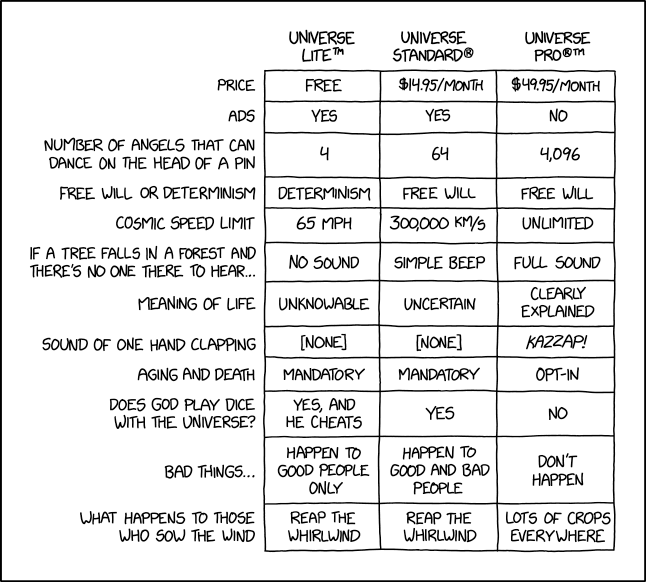
The first time I showed a room of managers a slide explaining how I keep track of my communication responsibilities, they laughed at me. They did try to hold it back because I’m the boss. But it didn’t work very well. And that’s fair. I don’t mind getting laughed at. I had sorted the people I work with into subscription tiers: daily, weekly, monthly, and custom, the way a SaaS company sorts a pricing page. Some people get a check-in every workday. Some get one every few weeks. It kinda reads like I built a CRM for my colleagues. And that can feel … weird.
I kept the slide. Not because the framing is elegant, but because everyone in that room already had subscription tiers for other people. Theirs just weren’t written down.
You already check in with some people every day; often almost on auto-pilot. You talk to others twice a year, usually at an offsite, and usually just because you ran into each other. There is a distribution of your attention across the organization and it is already extremely uneven. The question isn’t whether you have one, we all do. The question is whether or not it’s intentional.
What Sets the Distribution When You Don’t
Two things automatically fill the vacuum, and neither of them is your judgment about what matters.
The first is urgency. Attention flows to whoever is generating pressure right now: the escalation, the missed delivery date, the customer who is threatening churn. This feels like responsiveness and it gets rewarded like responsiveness. The squeaky wheel gets the grease, right? It also means the shape of your week can easily be set by whoever is having the worst one.
The second thing is less comfortable to admit. Unscheduled check-ins drift toward the people you like talking to. The peer who’s funny. The lead who gives you a clean answer in four minutes instead of a rambling one in twenty. Nobody actively decides this. It’s what happens when you have a spare fifteen minutes and a vague sense that you should be talking to someone. So you reach for the low-friction option, and low-friction, whether we like to admit it or not, usually means pleasant.
Without a deliberate system, urgency and enjoyment determine whom you contact and how often you contact them. The relationships that decay quietly are the ones that never generate pressure and/or were never especially fun. That likely describes a lot of the diagonal relationships you have. And when those relationships disappear, you lose more than the relationship itself. You lose a regular way of picking up context and feedback from parts of the organization you don’t otherwise see. It’s one of those things that doesn’t feel critical in the moment. But a Slack check-in with no agenda is often how you find out what you’ll need to know three weeks from now, about a decision you don’t even know is coming yet. This isn’t about micromanaging or routing around your direct reports. It’s about preserving access to ground truth by hearing external viewpoints so you aren’t making decisions or managing from an echo chamber.
Here is where a decaying diagonal relationship usually shows up. A customer success leader comes to you and asks whether your team can just look at one ticket, quickly, outside the normal support path. Sometimes the answer has to be no, because a side door that works too often stops being a side door and becomes another main entrance. Sometimes the escalation is legitimate and you make the exception. Either way, the conversation is much easier when this isn’t the first meaningful interaction you’ve had with that person in months.
You still need a clear operating model. Relationships don’t replace boundaries. But regular communication means you’re not trying to explain the operating model for the first time in the middle of an exception to it.
Only communicating when there is work to discuss trains people to associate your attention with a request. People learn that pattern fast. If you only appear when you need something, even showing up without a request can start to read less like goodwill and more like a preamble to being asked to do something.
Making the Distribution Explicit
Once the tiers exist as an actual list, I can check whether the distribution still matches where I think my attention should be going.
Sometimes it doesn’t. I’ve had a peer whose team I was blocking every week sitting at the same cadence as someone I had almost no dependency on at all. Seeing those two relationships represented the same way made it obvious that the list didn’t match reality.
That wasn’t visible while the distribution lived in my head as a general feeling about who I’d talked to lately. An unwritten allocation, one decided by feels, can’t be audited by anyone, including the person doing the allocating. A written one is a claim about where you think your attention belongs, and a claim can be checked.
It would be easy to read a tier list as a fairness instrument, a way of making sure nobody gets shortchanged. That isn’t what it’s for. Leadership attention is supposed to be uneven. A team in the middle of a hard migration or a complex system build should get more of my attention than a team that’s running fine. A major incident should pull everything toward it. A priority that doesn’t show up as a change in who I’m talking to every day isn’t really a priority.
The system is not there to distribute my attention evenly. It is there to make the unevenness intentional. What the list protects is the baseline underneath the concentration, so that a month of pouring everything into one team doesn’t quietly cost me every relationship that wasn’t in the room.
That doesn’t mean everyone on my team, let alone everyone in the company, belongs on the list. Attention and headspace are still finite. And part of your job as an executive is deciding where those should be directed for optimal impact. That includes deciding who needs to be on the list, at what frequency they should be contacted, and when someone can (or should) come off the list. If that list gets too large to maintain, cutting the check-in cadence or removing someone is better than maintaining a fictional commitment you can’t or won’t keep.
How the Sausage is Made
There are many tools for this, but I keep all of it in Todoist.
There’s a project for work, broken into sections. One section is daily check-ins: everyone on the technology leadership team (my direct reports), as a recurring task, every workday. One section is diagonal check-ins, each running at its own frequency, some daily, some every couple of weeks. One section is call-outs: one-offs I add as they occur to me and remove when they’re no longer relevant. Someone was out sick or on vacation and I want to check in when they’re back. Someone’s team shipped something last week and the release announcement got less fanfare than usual or understated the complexity or impact of the work. I want to make sure they feel seen.
Then there are the custom cadence check-ins. A major project might temporarily move someone from every couple of weeks to daily because I need much more context while the work is active. When the project ends, they go back down in frequency.
Most of these check-ins are Slack messages. A comment on something they posted, a question about work in flight, or just asking how the week is going. The channel is less important than maintaining the connection and being aware of the specific thing they’re working on. A scheduled 1:1 clears the task. So does an ad-hoc call (not a “do you have 5 minutes” from an executive since those requests are panic-inducing), or catching someone in the kitchen if we’re both in the office. What doesn’t clear it is manufacturing a conversation just to have one. If the outreach feels forced, people know it immediately, and nobody wants to feel like they’re being run through a CRM pipeline. If we’ve already naturally talked that day, or if there’s a quick follow-up to do, I check it off. Sometimes it’s simply a reminder to ask how something went and ensure the right people stay top of mind.
The list is most important where the calendar is thinnest. My direct reports already have standing 1:1s, so those tasks often get checked off by something that was going to happen anyway. The diagonal relationships rarely have something on the calendar. This is exactly why they’re the ones that quietly degrade. The relationships most likely to disappear aren’t necessarily the least important; they’re often just the ones with no recurring structure (like a regular calendar invite) protecting them.
And, unfortunately for anyone hoping this is just a weird management technique, I have a separate project for friends with roughly the same structure. Weekly. Monthly. Birthdays. Anniversaries. And some other random memories that I like to keep in mind.
But the tool isn’t the interesting part. Any recurring-task app can do this. The setup will take less than an afternoon. What matters is that a recurring task shows up whether or not I happened to think of the person, and thinking of the person was the exact step that kept failing in my ADHD brain. ADHD makes that failure mode more obvious for me, but it doesn’t create the underlying problem.
Relationships can be deliberately stepped down. Connections and project-specific check-ins can move to a lower cadence rather than disappearing because I stopped thinking about them. Writing the distribution down also makes it easier to test whether the cadence is still right. If I cut someone back for six weeks and nothing degrades, that cadence might have been too high to begin with. When a project ends, the daily check-in with that project’s lead becomes twice a week. I change the task. Most advice about professional relationships assumes permanence: build it, keep it, never let it lapse. That isn’t achievable across an organization of any size. What actually happens is that people keep everyone at peak frequency in principle, drop most of them in practice, and carry a low background hum of guilt about it. A step-down on the list is a decision instead of attrition. And it isn’t necessarily a negative signal. Sometimes the project ended. Sometimes the dependency went away. Sometimes someone grew enough that they simply don’t need as much of my attention anymore.
The cadence isn’t an SLA. The system is a reminder of intended attention, not a gamified streak. Some days I don’t get to everyone. Some days I don’t need to talk to a specific person. Sometimes the day gets away from me and the person’s gone by the time I look up. In that case, the task rolls over to the next day and I catch it tomorrow. Missing one isn’t a failure of the system. The cadence is there to keep someone from disappearing for three weeks because I got busy, not to make me manufacture a conversation at 5:45 because my task tracker says I’m overdue.
But This Feels Transactional
The objection I get most often, and the one I flinch at every time I present this, is that it feels transactional. Putting recurring reminders against relationships sounds like turning people into tasks. And there is something transactional about allocating a scarce resource like attention across a group of people.
But that transaction already exists in the version you’re running now. An unwritten distribution allocates your attention according to what you get back from people, which is usually either relief from pressure or enjoyment of their company. It just gets to feel spontaneous while doing it. Writing it down doesn’t introduce the transaction. It removes your ability to pretend there isn’t one.
The difference is that once the allocation is visible, you can start making it based on something other than urgency and your own comfort.
Don’t Be Pickle Rick
The laughter I got in that room wasn’t really about the tiers. Everyone in there was rationing attention across more people than they could hold in their head. What was funny was seeing it written down, with frequencies attached, in an app, like a chore. And it is a chore.
The thing about repairing, maintaining, and cleaning is it’s not an adventure…It’s just work.
– Dr. Wong (Susan Sarandon), Rick and Morty
This is the management version of that. Checking in on the people you’re responsible to and responsible for is part of the job. If I don’t give that work somewhere to live, it competes with everything else in the day using whatever heuristic happens to be running that afternoon.
The list does not tell me to give everyone equal attention. It tells me when a deliberate period of focus has quietly become neglect.
If you want more information on how I use subscription levels, I explain it starting at 16:16 in this video as part of the Managing in All Directions training.